Read for the journey. Learn for the next conversation.
Habits and ways of speaking vary by region, household and relationship. These are glimpses of everyday situations, rather than rules for everyone. These readings combine cultural information with imagined everyday scenes. People, conversations and images do not document a particular visit or event. Each accompanying image is an AI-generated illustration.
01
EVERYDAY NEPAL
Lanes & markets
From a place on the map to somebody’s neighbourhood.
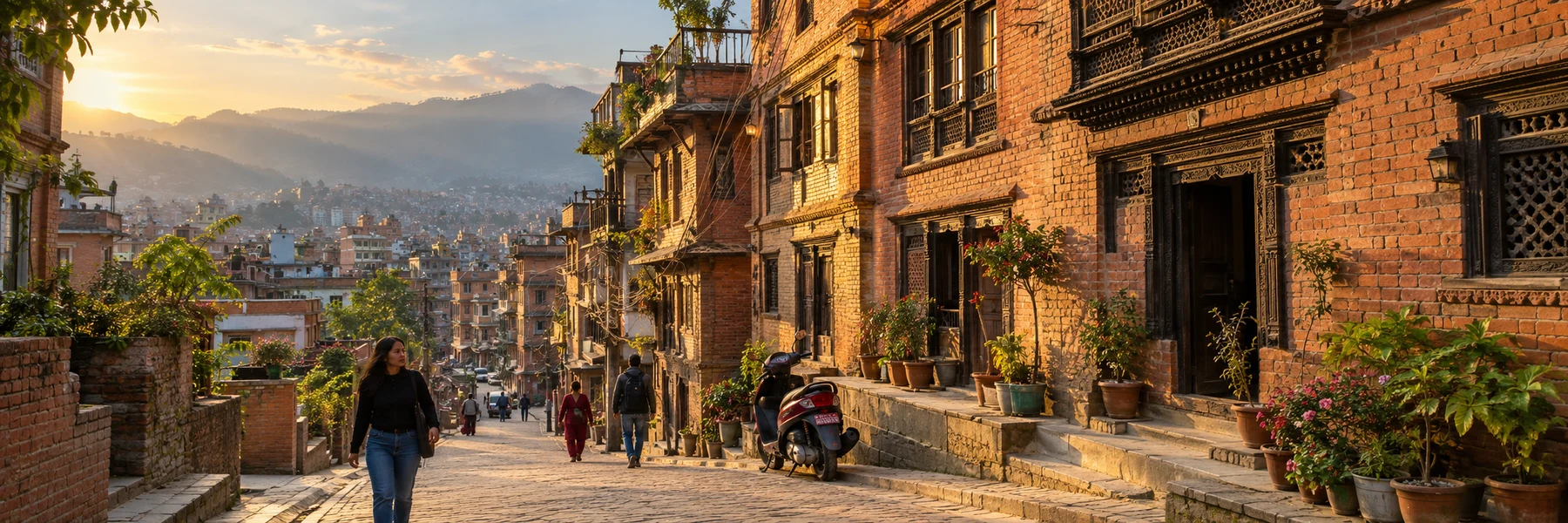
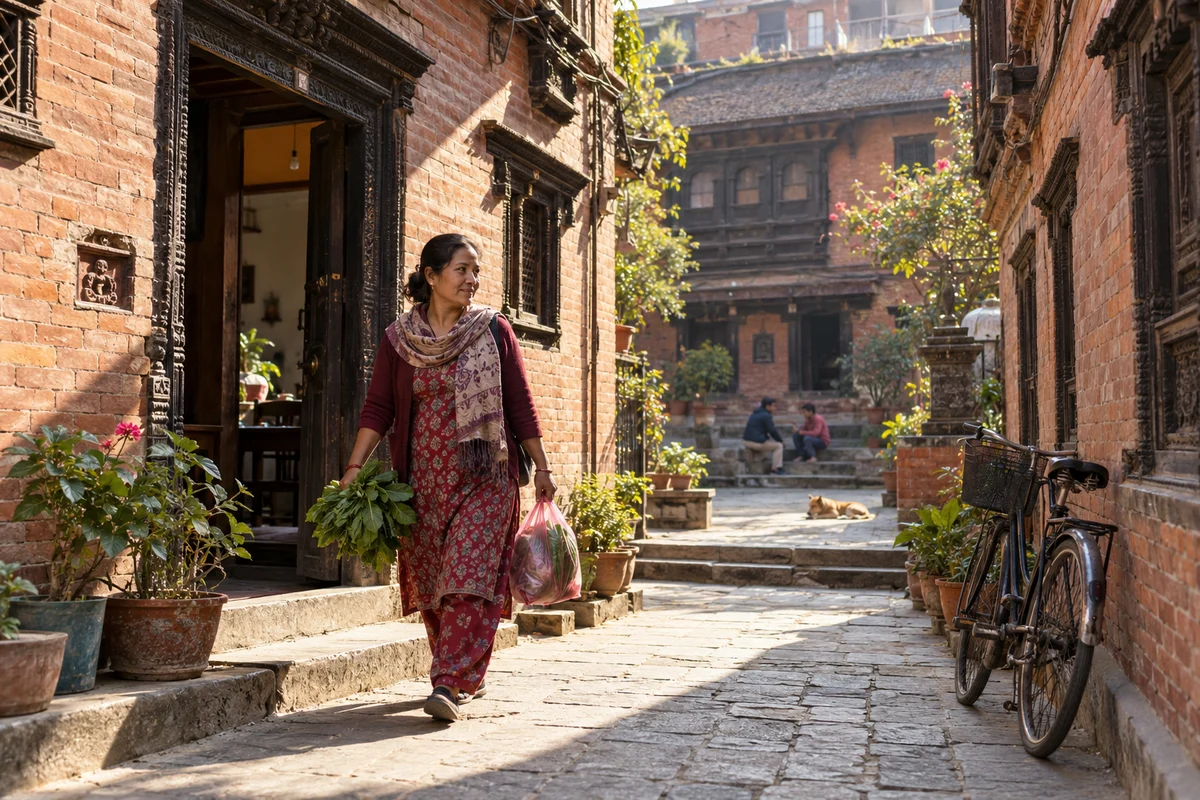
Morning light catches the brickwork. Beyond a square, the lane narrows beneath carved wooden windows. Someone carries vegetables through a doorway; a bicycle rests against the wall. Picture an old city that is still somebody’s neighbourhood, rather than a collection of buildings kept apart from everyday life.
Why three royal cities so close together?
Kathmandu, Patan and Bhaktapur flourished under Malla rulers and became centres of separate kingdoms. Their courts developed palaces, squares, religious buildings and the arts. In the late eighteenth century, Prithvi Narayan Shah of Gorkha brought the valley’s kingdoms under his rule, making Kathmandu the capital of the emerging state. The surviving city centres preserve different chapters of that history.
Three cities, three different starting points
Kathmandu, historically Kantipur, has the Hanuman Dhoka palace complex and its Durbar Square at the heart of the old city. Today’s capital places busy commerce and transport alongside those older streets. Patan, also called Lalitpur, rewards attention to craftsmanship: metalwork and woodcarving belong to the valley’s Newar artistic traditions as much as the palace square does. Bhaktapur, historically Bhadgaon, is associated with brick streets, royal squares and pottery-making. Exploring each city separately reveals more than treating all three as a single old town.
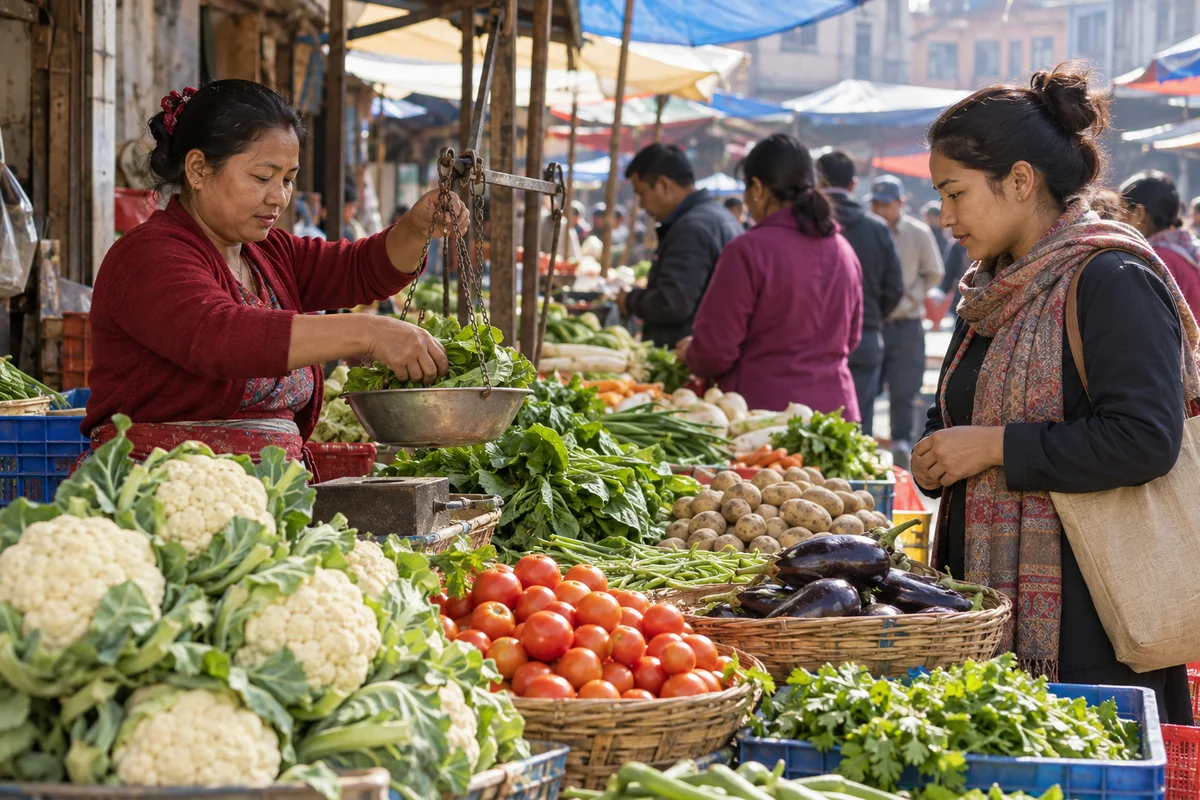
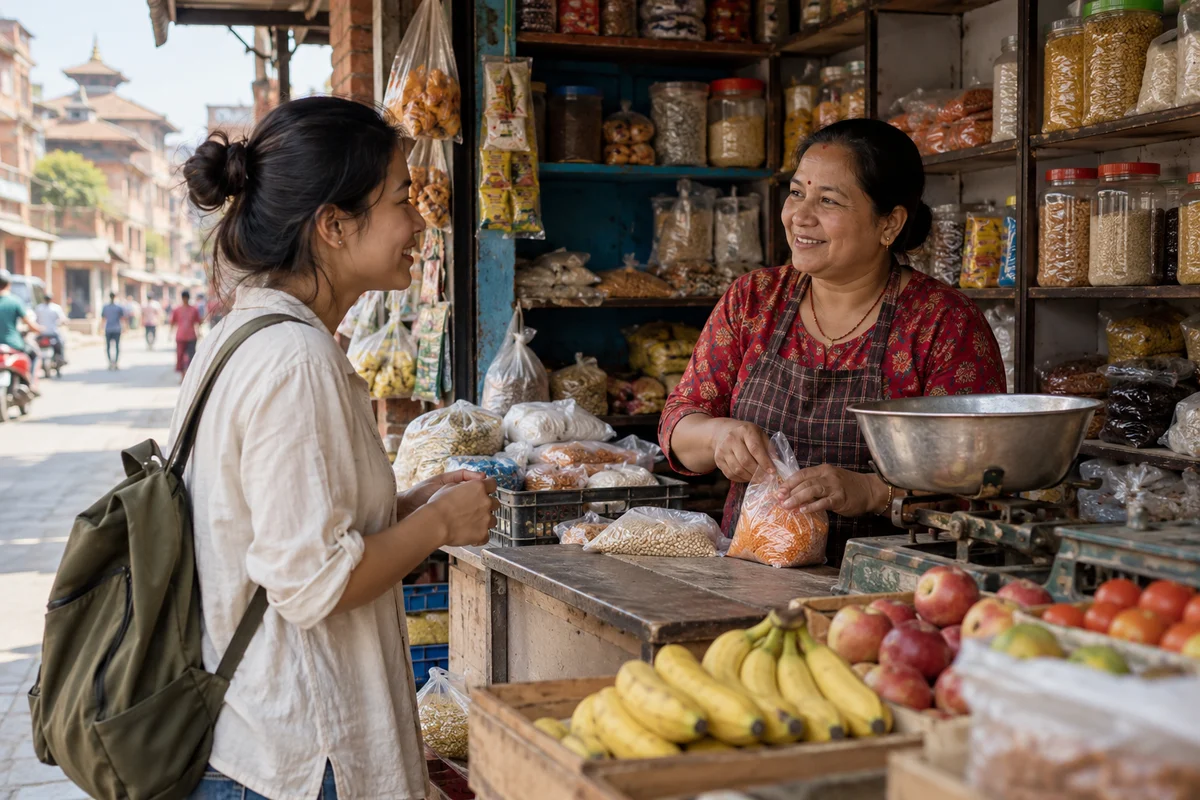
Tomatoes make a patch of red beside dark greens and potatoes still carrying a trace of earth. The vendor loads the scale while a customer opens a bag. What will it be, and how much? Around that brief exchange, other people are already choosing. The market has smaller sounds too: weights touching the pan, bags rustling, produce being set down.
A working place, not just a sight to see
A produce market supplies households and restaurants and forms part of the route from agriculture to urban meals. The stalls can suggest what is in season or commonly cooked. They do not all supply only nearby farms: trade between regions and imported goods also belong to city life. Looking at the market as a working system reveals more than its colours alone.
Asking the price is not the same as bargaining
Shopping questions connect the item, quantity and price. Some sellers discuss a price; other shops use fixed prices or do not treat the exchange as a negotiation. Watch how the particular shop works instead of assuming every transaction requires bargaining. Comparison and words such as a little can help express a preference without turning the purchase into a contest.
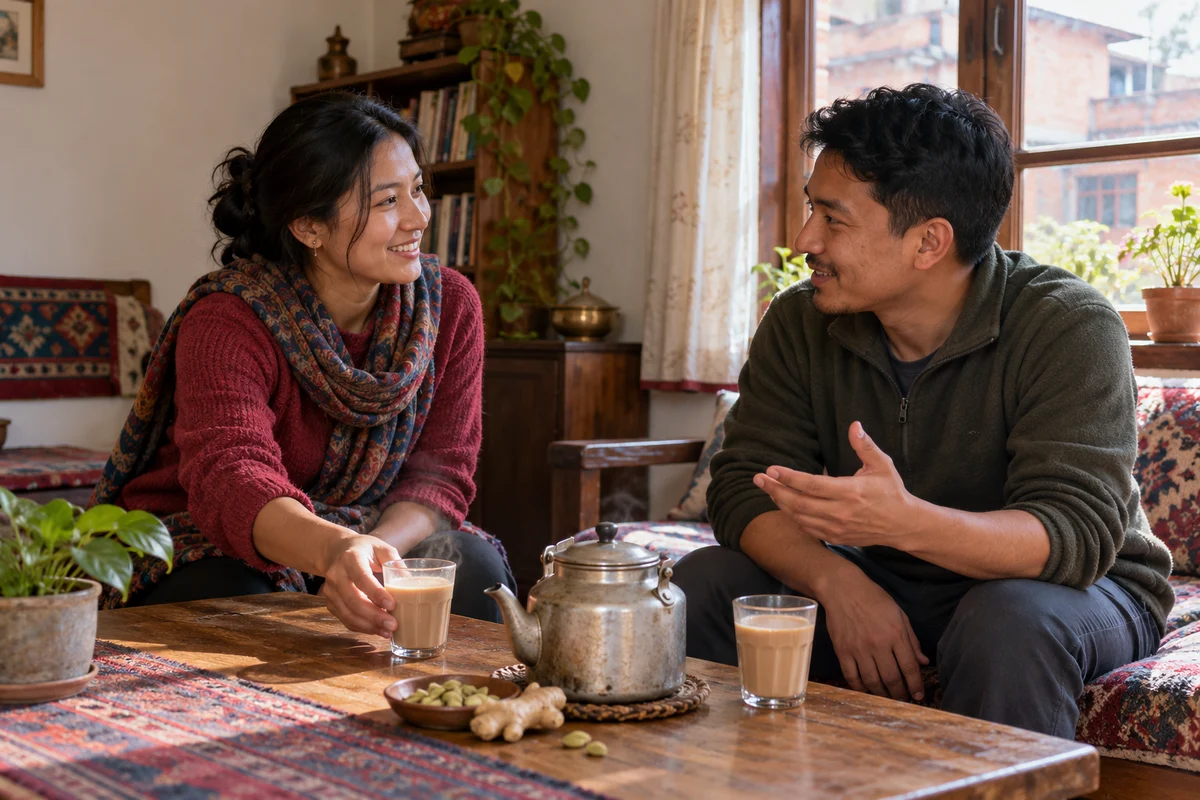
A glass lands softly on the table. Steam moves through the window light, and the first sip is still a little too hot. Outside, traffic continues; here, there is time for the next question. Where have you come from? Where are you going today? Imagine how the time needed to finish a cup can carry a greeting into a conversation.
What is chiya?
Chiya is the Nepali word for tea. Sweet tea with milk is familiar in homes and tea shops; some versions include ginger, cardamom or other spices. Sweetness, strength and seasoning differ from one maker to another. Tea without milk is also available, so there is no single taste that represents every Nepali cup.
A drink, and a place for people
Offering tea can be one way to welcome a visitor or make room for a break. A tea shop may also be a setting for neighbourhood news and work conversations. Hospitality is not a rule that obliges every visitor to drink. A warm greeting, thanks and an honest explanation of your preference are all part of the exchange.
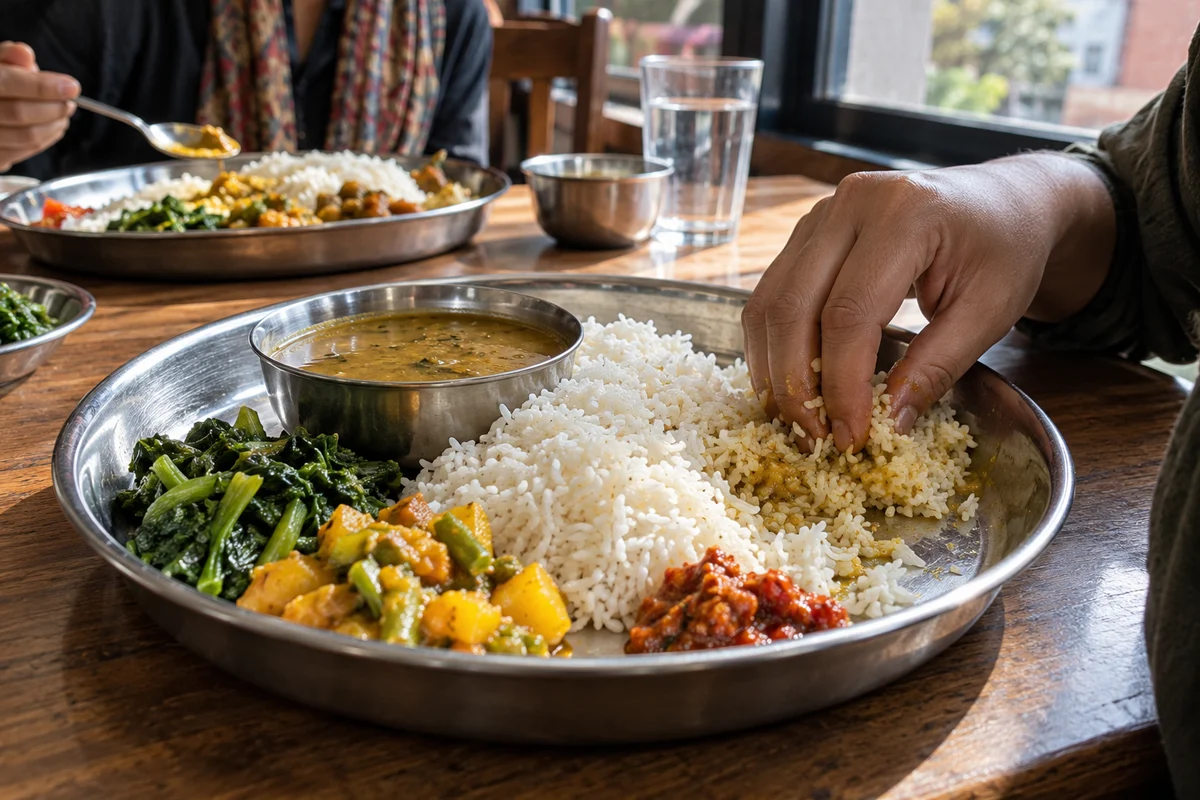
Rice sits on a steel plate beside a small bowl of steaming lentil soup. Vegetables bring other colours; a little achar waits at the edge. One mouthful can be mild with dal, the next richer with vegetables, another sharper with a small amount of pickle. The pleasure is in changing the combination rather than mixing everything together at once.
The names explain the meal
Dal is lentil soup and bhat is cooked rice. A familiar combination adds tarkari, a vegetable preparation, and achar, a pickle or relish. Leafy greens, meat or other dishes may appear too. Ingredients and seasoning vary with region, season and household; the name does not promise an identical set everywhere.
Eating by hand is not only a thing of the past
Using the right hand to combine a little rice with dal and other dishes remains a living practice. Hands are washed before and after the meal, and small portions are gathered with the fingertips. Spoons are also used, depending on the person and setting. The choice is not a simple division between an old way and a modern one: both belong to everyday food culture.
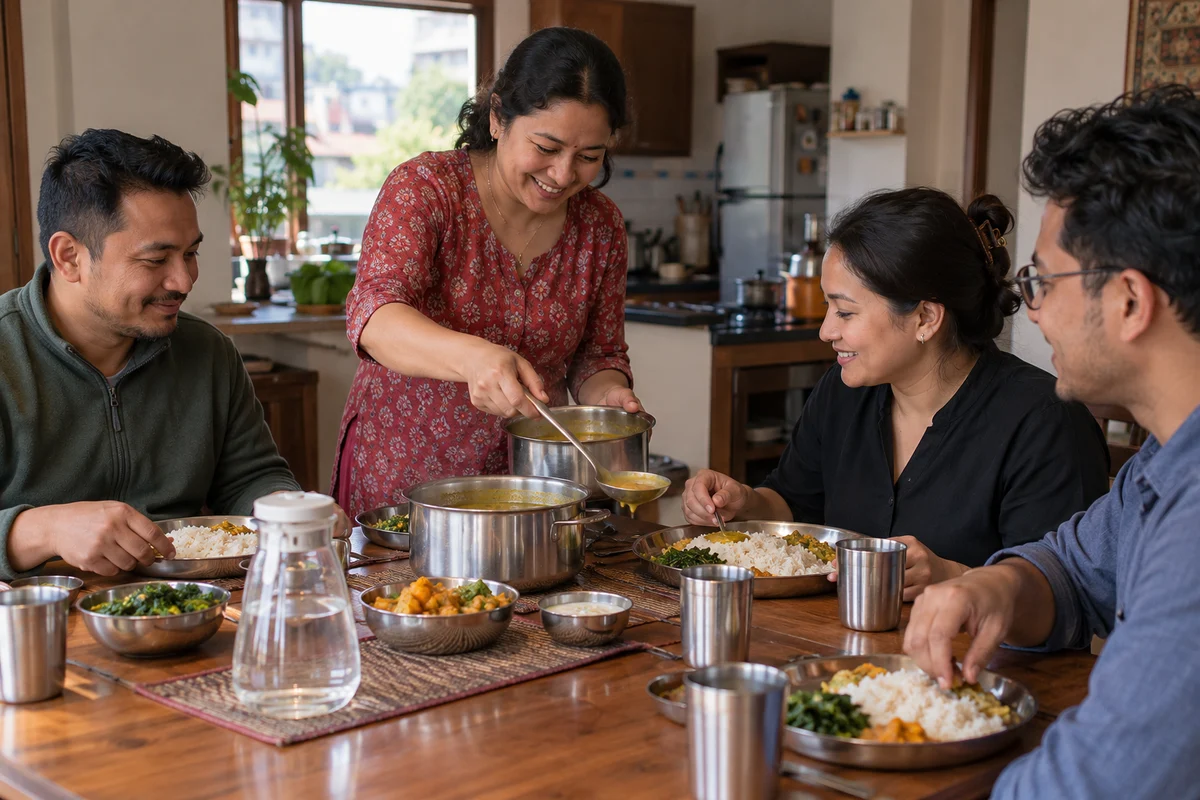
As the dal runs low, someone comes over with the pot and offers a little more. The exchange follows the guest’s pace, making attention to the person part of the meal. If you are full, appreciation and a gentle refusal can belong to the same conversation. Hospitality need not mean eating beyond comfort.
Sharing food does not mean sharing every utensil
The idea of jutho concerns food or objects affected by contact with someone’s mouth or saliva. In some settings, keeping a serving utensil separate from what goes to one’s own mouth matters. Practices vary with household and relationship, including within close families. It is a cultural context for handling food, rather than a reason to assume everyone follows exactly the same rule.
Notice how the table works
The right hand is preferred for eating or passing things in some settings, with traditional ideas of cleanliness in the background. Present-day practice is varied. At a host’s table, noticing how food is served can be more useful than turning a general description into a rigid rule. A little understanding helps small acts of consideration become visible.
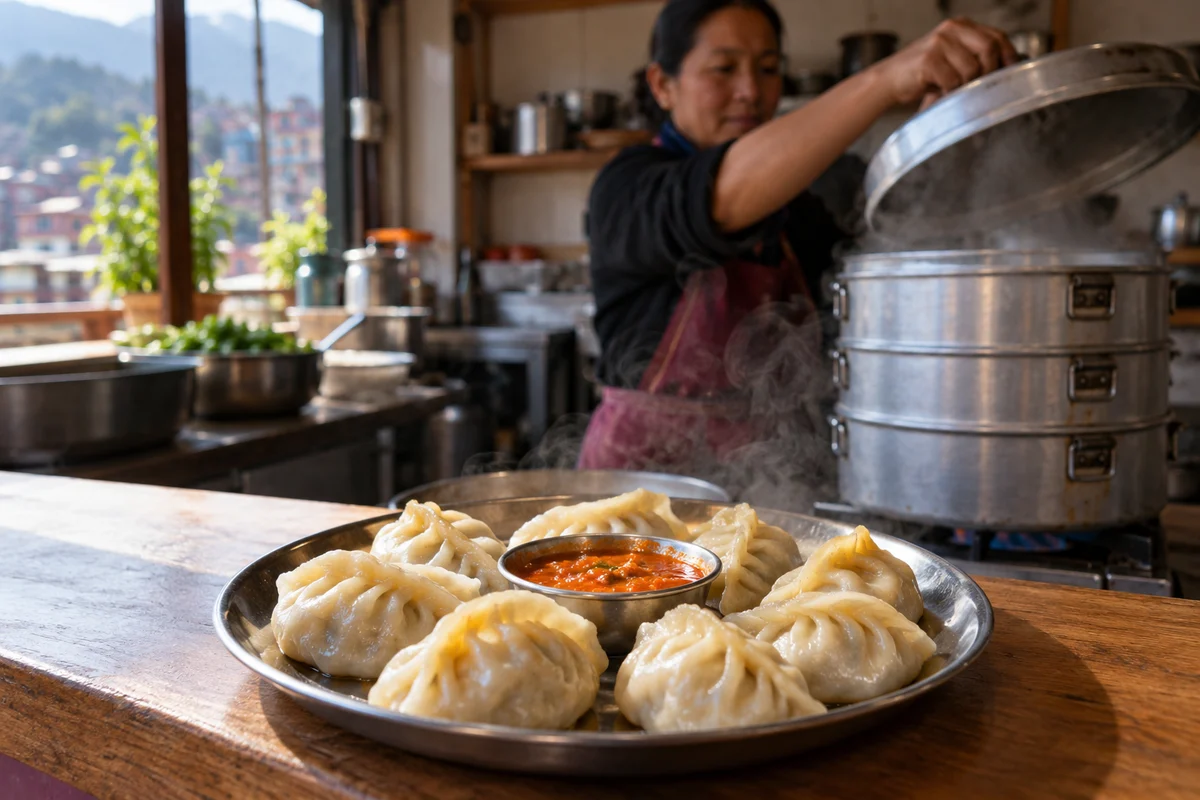
The lid comes off a metal steamer, revealing rows of momo through a cloud of steam. Their folds are not quite identical. A small dip in sauce brings the soft wrapper and filling together. Waiting for a warm plate at a neighbourhood shop can be as much a part of the experience as the first bite.
A familiar dish with many versions
Momo are filled dumplings widely enjoyed in Nepal. Fillings can include meat, vegetables or cheese, and cooking styles include steaming and frying. The filling, sauce and level of heat can make two plates feel quite different. They also offer a glimpse of Nepal’s culinary connections with neighbouring regions, including Tibet and India.
A plate creates reasons to ask
Which fillings are available? Are these steamed? How hot is the sauce? Choosing a meal creates small, real reasons to speak. Asking the person who makes it may reveal something the plate alone cannot. Learning a food’s name is a start; describing your own preference makes the exchange more personal.
03
EVERYDAY NEPAL
People, festivals & daily life
The stories behind a form of address and a street full of lights.
A customer pauses over the goods and calls the shopkeeper didi. They need not be related, yet the address gives the exchange a warmer tone. Before the question about an item or its price comes a small recognition of the person across the counter. An ordinary purchase can contain more than goods and payment.
Kinship words can reach beyond the family
Dai refers to an elder brother and didi to an elder sister. They can also address an older person outside the family. Bhai and bahini refer to younger siblings, but these words should not be assigned mechanically to every stranger. Age, familiarity and the particular relationship all affect what feels appropriate.
Warmth does not remove respect
Nepali also expresses relationships through pronouns and verb forms. A family-like form of address does not automatically invite very informal speech. Listening to how people address one another is often more useful than memorising a label alone. The word opens a window onto how familiarity and respect can exist together.
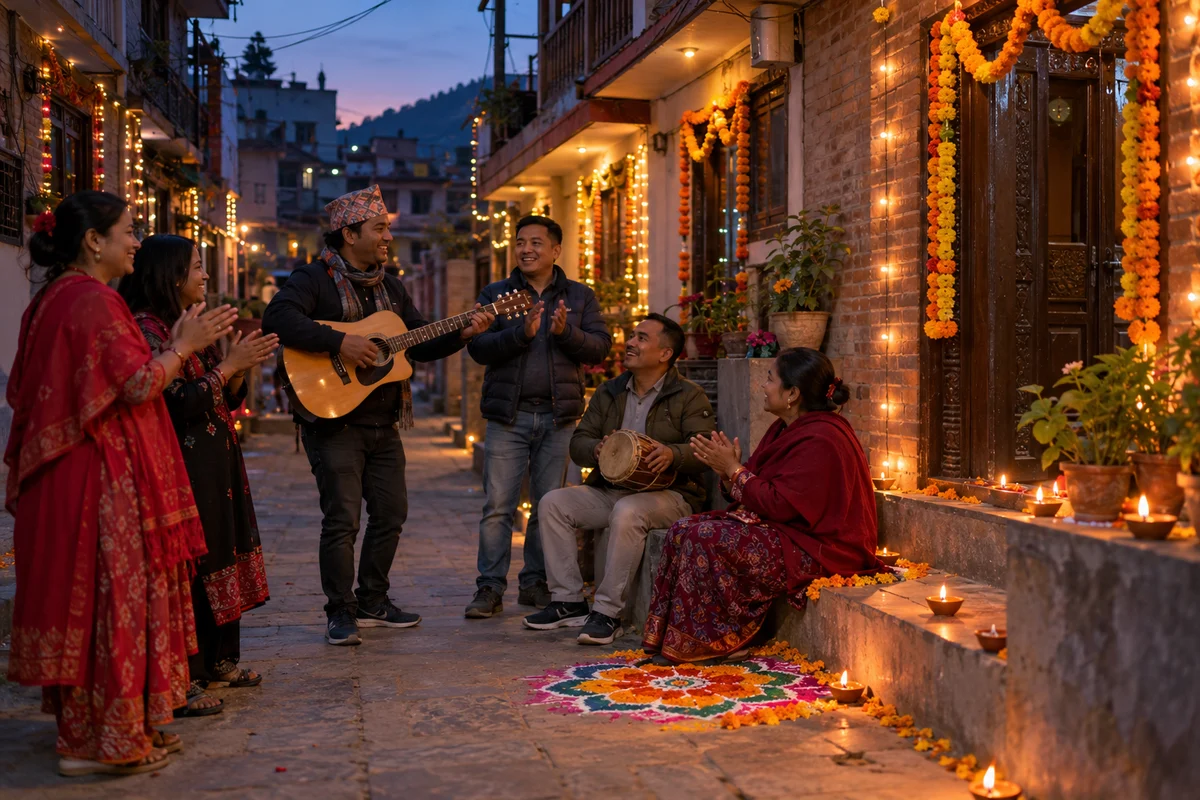
At dusk, small lights appear along entrances and windows. Orange garlands frame a doorway; coloured patterns brighten the ground. Singing approaches from farther down the lane, and people linger where they usually pass through. Imagine an ordinary street taking on another rhythm as Tihar reaches the evening.
What happens during Tihar?
Tihar is generally a five-day festival with roots in Hindu traditions. Different days honour animals including crows, dogs and cows. Lights welcome Lakshmi, associated with wealth and prosperity, while Bhai Tika centres on bonds between siblings. These religious meanings help explain the festival’s place in everyday life and the calendar; they are described here as cultural background.
The decorations belong to a wider tradition
Visits with Deusi and Bhailo songs bring people together, while garlands and lights connect the street to household celebrations. Dates shift with the calendar and practices vary. Newar communities also observe Mha Puja during this festival period. One season of celebration can therefore contain several traditions rather than a single uniform experience.
04
EVERYDAY NEPAL
Beyond the mountains
A country with more than one landscape or way of life.
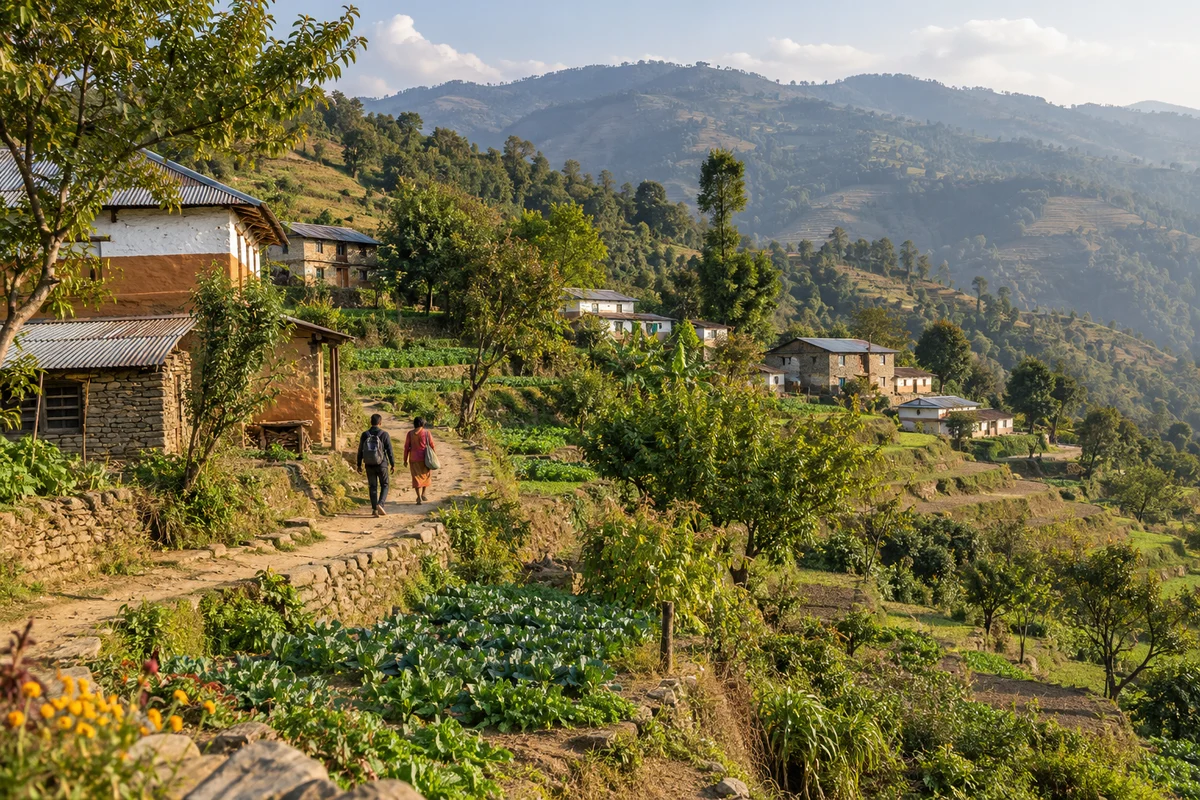
A narrow path crosses the slope towards a cluster of roofs. Fields step down the hillside; vegetables grow close to the houses. For somebody walking here, the route is not simply a scenic trail. It also connects home with fields, school and the nearest shop. The view contains the shape of an ordinary working day.
Agriculture is part of the country’s story
Nepal includes middle hills and the southern Tarai plains as well as the high Himalaya. Agriculture supports many livelihoods, with crops shaped by elevation, water and season. Rice, maize, wheat, millet and vegetables belong to different farming settings. Terraces are not merely patterns in a photograph: they are a way of cultivating sloping land.
Mountain tourism is more than climbing
A mountain journey involves more than climbers and guides. Porters, lodge owners, cooks, equipment shops and transport workers all help make a visit possible. Some households combine farming with tourism-related work, and seasonal demand can change the balance. Looking at the work behind a field or a lodge adds another layer to the scenery.
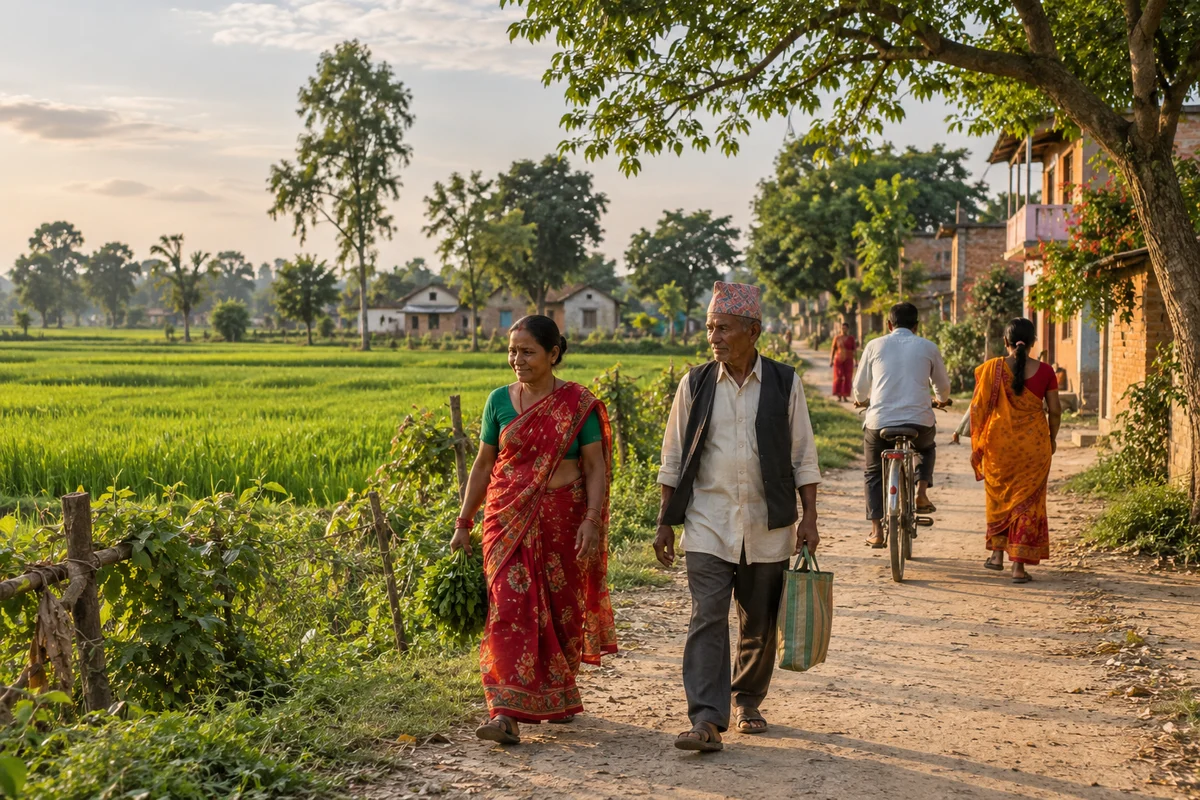
Fields stretch into the distance, and a bicycle follows a shaded lane. No snowy peak fills the horizon, yet this too is Nepal. The Tarai lowlands, middle hills and high mountains support different crops, journeys and kinds of work. A photograph of the Himalaya cannot contain the country’s whole working day.
Agriculture, tourism and urban services
Agriculture matters both for food and for many livelihoods. Tourism connects mountain trips and historic-city visits with accommodation, food and transport jobs. Yet these two sectors do not explain the whole economy. Commerce, transport, finance, construction, manufacturing and hydropower also have roles. What a country is famous for is not the same question as everything that supports its economy.
Connections with relatives working abroad
Money sent home by people working overseas is another important part of household income and consumption. Remittances are not an industry in the same sense as farming or tourism, but they connect with housing, education and everyday purchases. A family’s story may therefore reach far beyond the village or city where the conversation begins.
Leave room for differences
Languages, foods, dress, festivals and religious backgrounds are varied too. A practice in one household need not represent another. Learning Nepali as a shared language can sit alongside curiosity about local languages and work. Knowing more words does not erase those differences; it helps you notice and ask about them.
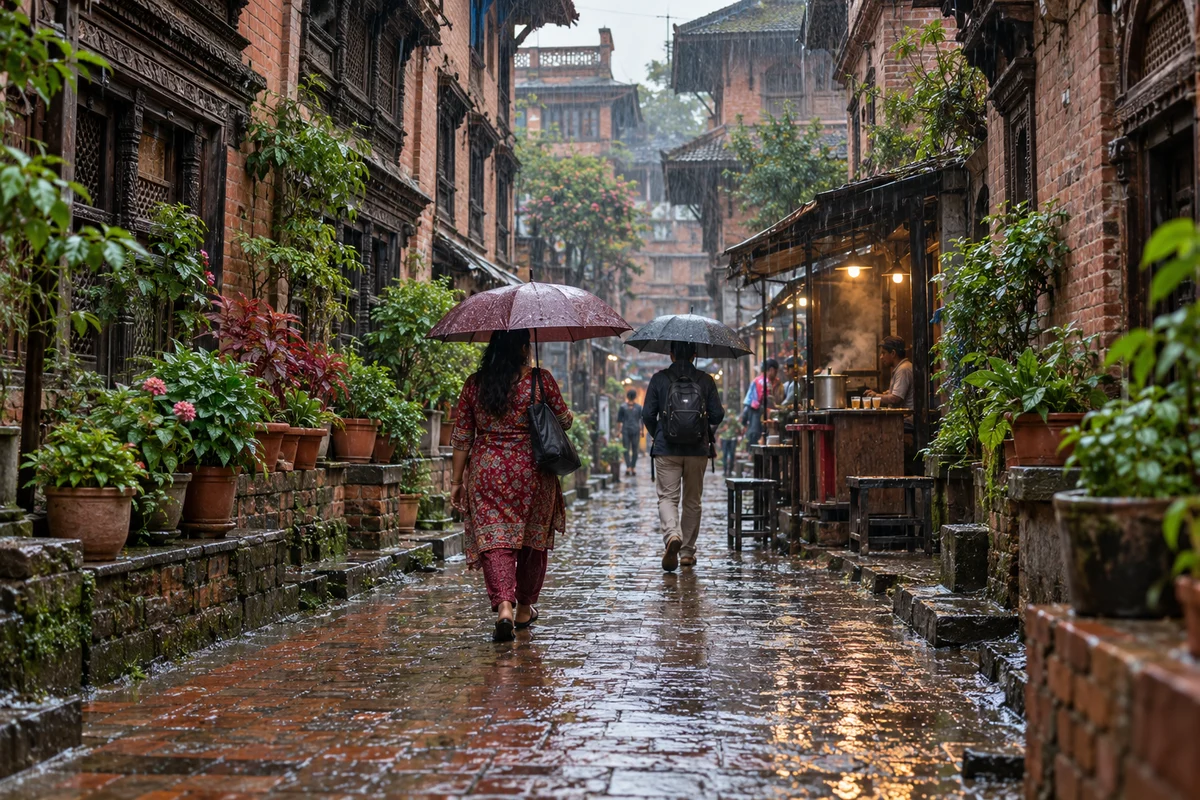
Rain taps against umbrellas; tea steams beside a wet brick lane. The monsoon generally runs from June to September. Fields grow greener and clouds can hide the mountains, though rain need not fall continuously.
Dry months, cold mornings and summer heat
Autumn through spring is generally drier. October and November often bring clear mountain views; winter mornings are cold, and spring brings flowers before the heat builds. Wet and dry describe rainfall, while summer and winter describe seasonal warmth.
One country, different temperatures
Kathmandu, Pokhara and lowland Chitwan have different summer nights and winter mornings. Higher mountains can stay cool in summer and fall below freezing in winter. Think about the place and altitude, rather than one temperature for all Nepal.
Summer and winter: typical high / low temperatures
Place
Summer (May–Jul)
Winter (Dec–Feb)
Kathmandu
28.1°C / 19.5°C
19.3°C / 3.0°C
Pokhara
29.7°C / 21.3°C
20.3°C / 7.7°C
Chitwan
33.0°C / 25.3°C
24.1°C / 8.3°C
Each cell gives average high / low temperatures from Nepal Tourism Board’s seasonal table. These are guides, not daily forecasts or record extremes; conditions vary by year and location.